Agile scaling models in 60 seconds
- The main models: SAFe, LeSS, Scrum@Scale, Nexus, the Spotify model, and your own hybrid.
- Most organisations blend: 74% use hybrid, blended or homegrown agile models.[1]
- What they share: a joint plan, visible dependencies, a cross-team sync and a review of results.
- What Kendis does: provides those four on boards you configure to your model, synced with Jira and Azure DevOps.
- You are not locked in: the same boards work if your model changes.
What is an agile scaling model?
An agile scaling model is a way of organising many agile teams so they can plan, coordinate and deliver together. It defines how teams are grouped, how often they plan jointly, who coordinates between them and how work connects to strategy. SAFe, LeSS, Scrum@Scale and Nexus are published frameworks. The Spotify model is a well-known example of a company's own design.
The models differ in how much they prescribe. They agree on what has to exist. Whichever you choose, you need four things: a shared plan made on a cadence, a way to see dependencies between teams, a regular cross-team sync, and a look back at results. Kendis is built around those four, which is why it can support any of the models below.
For a full comparison of the frameworks themselves, including when to scale and how to start, read the scaling agile guide.
How do the agile scaling models compare?
SAFe is the most prescriptive and reaches from team to portfolio. LeSS and Nexus stay close to Scrum for one product. Scrum@Scale links teams through a Scrum of Scrums. The Spotify model favours autonomy with squads and tribes. Each maps to a different board set-up in Kendis.
| Model | Stated size | Joint planning | In Kendis |
|---|---|---|---|
| SAFe | 50 to 125 people per Agile Release Train[2] | PI Planning every 8 to 12 weeks[3] | Program board per ART, solution board across ARTs, PI Objectives, ROAM, confidence vote |
| LeSS | Up to eight teams, more with LeSS Huge[4] | One sprint planning across teams | One board with all teams and sprints for the product |
| Scrum@Scale | Scrum of Scrums of four or five teams[5] | Scaled events per Scrum of Scrums | Connected boards, with a Scrum of Scrums view for impediments and actions |
| Nexus | About three to nine Scrum teams[6] | Nexus Sprint Planning | One board for the Nexus with cross-team dependencies |
| Spotify model | Tribes of around 100 people[7] | Not defined | Board per tribe, squads as teams, objectives aligned to tribe goals |
| Your own model | Whatever you decide | Your cadence | Your own board layout, levels and KPIs |
How does Kendis support SAFe?
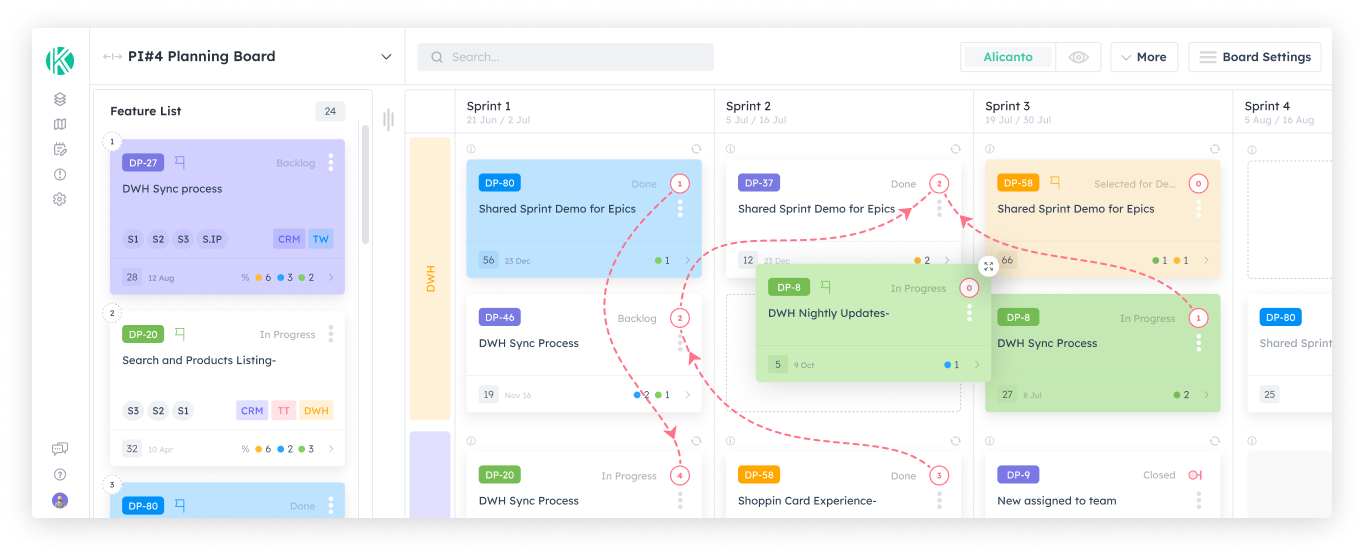
Kendis covers SAFe from team to Large Solution: a program board for PI Planning with team capacity, dependencies, PI Objectives with business value, a ROAM risk register, the confidence vote, Inspect and Adapt, and a solution board across Agile Release Trains.
SAFe organises teams into Agile Release Trains, each "a long-lived team of Agile teams"[2], which plan together in a Planning Interval of 8 to 12 weeks.[8] Kendis follows that structure:
- Program board with a row per team and a column per iteration, for PI Planning in a room or remotely.
- Dependencies drawn on the board, with owners, dates and alerts.
- PI Objectives with planned and actual business value, linked to features.
- ROAM risk register and a built-in confidence vote.
- Inspect and Adapt with predictability and comparisons between PIs.
- Solution board for Solution Trains, the construct SAFe uses "to build large solutions that requires the coordination of multiple ARTs and suppliers."[9]
- Strategic themes and OKRs for the portfolio level.
Related guides: Agile Release Train, Release Train Engineer, WSJF, ROAM.
How does Kendis support LeSS?
For LeSS, Kendis puts every team working on the product and all their sprints on a single board, so the one Product Owner and all teams see the same plan, the same backlog items and the dependencies between them.
LeSS applies one-team Scrum to many teams: one product, one Product Owner, one backlog and one sprint. Basic LeSS covers up to eight teams, and LeSS Huge extends to a few thousand people on one product.[4] LeSS prefers feature teams precisely because they minimise "dependencies between teams to increase flexibility."[10] The board makes the remaining dependencies visible so they can be designed away.
- All teams and sprints for the product on one real-time board.
- Progress of every backlog item without opening each team's Jira board.
- Dependencies shown where they exist, as evidence for restructuring.
- An overview for the Product Owner and, in LeSS Huge, for Area Product Owners.
How does Kendis support Scrum of Scrums and Scrum@Scale?
Kendis provides a place to run the Scrum of Scrums: impediments, action items and progress across teams on one view. Boards can be connected, so the same pattern repeats for a Scrum of Scrum of Scrums.
Scrum@Scale links teams through a Scrum of Scrums, and its guide states that "the optimal number of teams in a Scrum of Scrums is 4 or 5."[5] Larger organisations repeat the pattern at the next level up. In SAFe the equivalent event is now the Coach Sync, part of the ART Sync.[11]
- Scrum of Scrums view with impediments, actions and reminders.
- Story and feature progress for every team in one place.
- Dependencies visualised and tracked between the teams in the group.
- Connected boards that scale up to a Scrum of Scrum of Scrums or MetaScrum.
How does Kendis support Nexus?
A Nexus is set up in Kendis as one board for its three to nine Scrum teams, with cross-team dependencies and a shared view of the sprint, which is what the Nexus Integration Team needs to see.
The Nexus Guide defines a Nexus as "a group of approximately three to nine Scrum Teams that work together to deliver a single product."[6] It exists "to minimize and manage dependencies between multiple Scrum Teams", and its Nexus Sprint Backlog "is used to highlight dependencies and the flow of work during the Sprint."[6] A Kendis board gives that view directly from the teams' Jira or Azure DevOps data.
How does Kendis support the Spotify model?
For squads and tribes, Kendis gives each tribe a board with its squads as teams, lets squads set goals that align to the tribe's, and shows dependencies between squads without taking away their autonomy.
The Spotify model comes from a 2012 paper describing how Spotify had "scaled to over 30 teams across 3 cities" using squads, tribes, chapters and guilds, with tribes kept to around 100 people.[7] It was a description of one company at one time, not a framework, and it says little about joint planning. That is the gap a shared board fills.
- Tribes and squads modelled as boards and teams.
- Squad objectives linked to tribe and company goals with OKRs.
- Dependencies between squads visible, so autonomy does not turn into surprise.
- An organisation-level view across tribes in ORG Views.
What if you use your own scaling model?
Most organisations do. Kendis lets you define your own board layouts, levels, terminology and KPIs, so the tool follows your process and not the other way round.
In Digital.ai's 18th State of Agile Report, 74% of respondents said they use hybrid, blended or homegrown agile models.[1] A common shape is SAFe-style cadence and planning at programme level, squads and tribes inside the trains, and Scrum or Kanban in each team. Kendis supports that mix because its building blocks are generic:
- Boards for any grouping of teams and any cadence.
- An organisation tree with your own levels in ORG Views.
- Kanban boards for continuous flow alongside iteration-based boards.
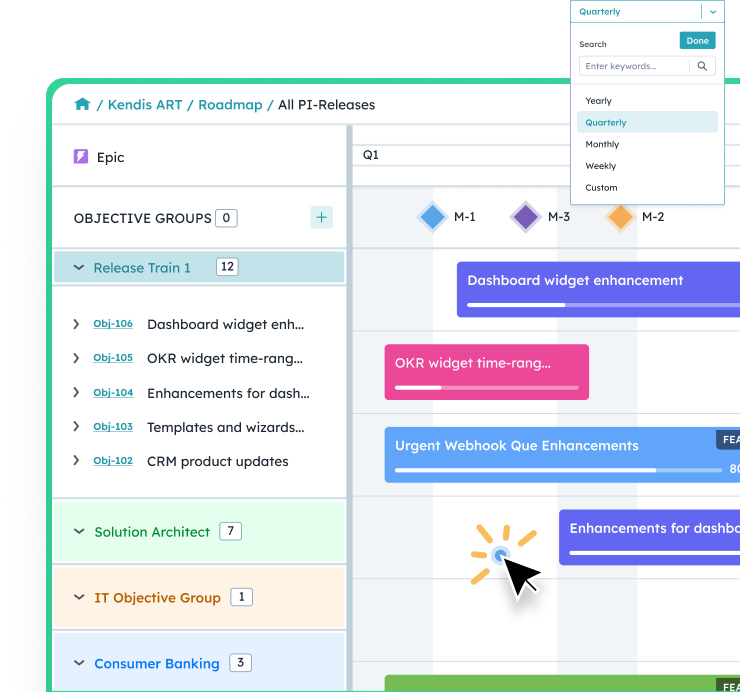
- Custom objectives for milestones and releases as well as PIs.
- Your own names for things. Call it a PI, a quarter or an increment.
How do you choose an agile scaling model?
Match the model to four things: how many teams you have, whether they build one product or several, how much governance your industry requires, and how much change your culture will accept. Start with the lightest model that solves your coordination problem.
| If you have | Consider |
|---|---|
| One product, up to eight teams, appetite for organisational change | LeSS |
| Three to nine Scrum teams on one product | Nexus |
| Scrum established and a need to link groups of teams | Scrum@Scale |
| Many teams, several products, strong governance or regulation | SAFe |
| A product culture that prizes team autonomy | Squads and tribes, with a shared planning cadence added |
| None of these fits cleanly | A hybrid. You are in the majority. |
The scaling agile guide goes deeper on the choice, the readiness check and the metrics that show whether it is working.
Try Kendis with your scaling model, free for 6 months
Kendis is a PI Planning and tracking platform that sits on top of Jira and Azure DevOps. The free trial runs for six months, long enough to plan and track two full PIs with your real backlog before anyone has to approve a budget.
- 6 months free, no credit card
- Choose EU hosting (OVHcloud, Frankfurt) or US hosting (AWS)
- Planning board, dependencies, PI objectives, ROAM risks, solution boards
- Two-way sync with Jira Cloud, Jira Data Center and Azure DevOps
- ISO/IEC 27001 certified, GDPR compliant, DORA Schedule available
- No user caps and no setup costs during the trial
One trial per organisation that has not used Kendis in the last twelve months. After the trial, Premium Cloud is $14 per user per month billed annually, or $16 monthly, and you license only the people who plan. SSO, Kendis AI and premium support are part of paid plans. See pricing and the free trial terms.
Agile scaling models: frequently asked questions
What are the most popular agile scaling models?
SAFe (Scaled Agile Framework), LeSS (Large-Scale Scrum), Scrum@Scale, Nexus and the Spotify model of squads and tribes. Many organisations combine elements of several.
What is the difference between SAFe and LeSS?
SAFe is prescriptive, with defined roles, events and configurations from team to portfolio, organised around Agile Release Trains of 50 to 125 people. LeSS keeps standard Scrum with one Product Owner and one backlog for up to eight teams, adding very few roles.
What is Scrum of Scrums?
Scrum of Scrums is a coordination pattern where representatives of several Scrum teams meet regularly to align on dependencies and impediments. In Scrum@Scale the optimal number of teams in a Scrum of Scrums is four or five.
What is the Spotify model?
The Spotify model organises people into squads (small cross-functional teams), tribes (groups of squads in a product area), chapters and guilds. It comes from a 2012 paper describing Spotify at that time and was not published as a framework.
Can you combine agile scaling models?
Yes, and most organisations do. A common hybrid uses SAFe-style cadence and joint planning at programme level, squads and tribes inside trains, and Scrum or Kanban in each team.
Which scaling models does Kendis support?
Kendis supports SAFe, LeSS, Scrum@Scale and Scrum of Scrums, Nexus, the Spotify model and custom hybrids. Boards, levels and terminology are configurable, and data syncs two-way with Jira and Azure DevOps.
Do I have to change tool if I change scaling model?
Not with Kendis. The same boards, dependencies, objectives and risks work across models, so you can adjust the set-up as your way of working changes.
Is Kendis only for SAFe?
No. Kendis has the deepest feature set for SAFe PI Planning, but its boards, dependencies, objectives and reports work for any group of agile teams that plan and deliver together.
Sources
Every external claim in this guide links to the primary source below. All links were checked on 12 October 2026.
- Digital.ai. 18th State of Agile Report press release (28 October 2025).
- Scaled Agile, Inc. Agile Release Train.
- Scaled Agile, Inc. PI Planning.
- The LeSS Company. What is LeSS? LeSS Framework.
- Scrum Inc. The Scrum@Scale Guide, version 2.1 (February 2022).
- Scrum.org. The Nexus Guide (January 2021).
- Henrik Kniberg and Anders Ivarsson. Scaling Agile @ Spotify with Tribes, Squads, Chapters and Guilds (October 2012).
- Scaled Agile, Inc. Planning Interval (PI).
- Scaled Agile, Inc. Solution Train (Extended Guidance).
- The LeSS Company. Feature Teams.
- Scaled Agile, Inc. Essential SAFe.
How this page is maintained: framework descriptions are checked against each framework's own published guide, linked above. Statements about Kendis come from Kendis. SAFe is a registered trademark of Scaled Agile, Inc. LeSS, Scrum@Scale and Nexus are trademarks of their respective owners.