Agile roadmaps in 60 seconds
- Definition: SAFe defines a roadmap as "a schedule of events and milestones that forecasts and communicates planned solution deliverables over a time horizon".[1]
- Agile difference: an agile roadmap is a forecast that is revised every increment, not a fixed plan.
- Types: product, portfolio, solution, PI, OKR and strategic roadmaps, each for a different audience and horizon.
- Formats: timeline, Now-Next-Later, outcome based and theme based.
- In SAFe: a PI roadmap typically covers three PIs; the first is committed and the next two are a forecast.[2]
1. What is an agile roadmap?
An agile roadmap is a high-level plan that shows the outcomes, features and milestones a product or organisation intends to deliver over time, and that is updated regularly as teams learn. It communicates direction and priorities, links work to strategy, and separates near-term commitments from longer-term forecasts.
Atlassian describes a product roadmap as "a shared source of truth that outlines the vision, direction, and progress of a product over time".[3] SAFe calls it a planning tool "that visualizes deliverables and milestones during a time frame".[2] What makes a roadmap agile is not its shape but how it is used:
- It is a forecast. Near-term items are firm, later ones are expected but open to change.
- It is outcome led. Items trace back to a goal, objective or strategic theme.
- It is reviewed on a cadence. Every PI, quarter or planning event, not once a year.
- It stays above the backlog. Features and epics on the roadmap, stories and tasks in the team backlog.
2. Roadmap vs backlog vs release plan vs Gantt chart
A roadmap shows direction and outcomes over months or years. A backlog is the ordered list of work the teams will pull from. A release plan or PI plan commits a specific scope for the next increment. A Gantt chart schedules tasks on a calendar. Agile organisations usually need the first three and use the fourth only at feature level.
| Roadmap | Backlog | Release or PI plan | Gantt chart | |
|---|---|---|---|---|
| Question it answers | Where are we going, and roughly when? | What is next, in what order? | What will we deliver this increment? | When does each task happen? |
| Unit | Outcomes, epics, features | Features and stories | Features with team owners | Tasks |
| Horizon | Months to years | Ongoing | One increment | Whole project |
| Commitment | Forecast | None until pulled | Committed | Plan to follow |
In Scrum, the long-term target lives in the Product Goal, which "describes a future state of the product which can serve as a target for the Scrum Team to plan against".[4] A roadmap makes that goal, and the steps towards it, visible to everyone outside the team. For when a timeline view helps and when it hurts, see the agile Gantt chart guide.
3. Types of roadmaps
The main roadmap types are the product roadmap, the portfolio roadmap, the solution roadmap, the PI roadmap, the OKR roadmap and the strategic roadmap. They differ in scope, owner, content and time horizon, and in a scaled organisation they nest inside each other.
| Type | Scope | Owner | Shows | Typical horizon |
|---|---|---|---|---|
| Product roadmap | One product | Product Manager | Features, releases, goals | 6 to 18 months |
| Portfolio roadmap | A portfolio of value streams | Portfolio leadership, LPM | Epics and investment themes | Multiyear |
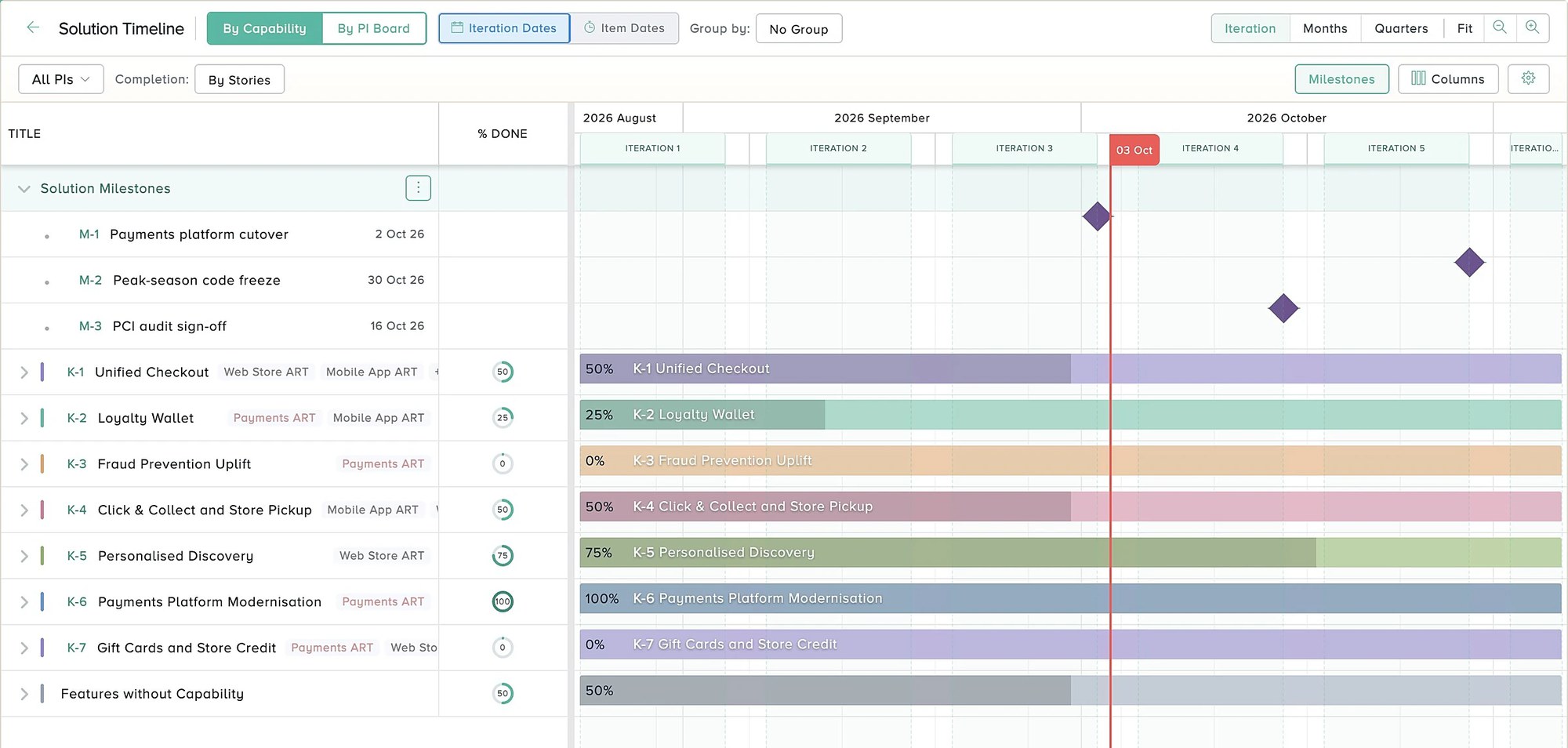
| Solution roadmap | A large solution across trains | Solution Management | Capabilities and milestones | 1 to 2 years |
| PI roadmap | One Agile Release Train | Product Management, RTE | Features by PI | Usually 3 PIs |
| OKR roadmap | Any level | Leadership with teams | Objectives and key results over time | Quarters |
| Strategic roadmap | The organisation | Executives | Themes, outcomes, major bets | 1 to 3 years |
SAFe names three of these explicitly: PI roadmaps for an Agile Release Train or Solution Train, product and solution roadmaps for a longer view of milestones and deliverables, and portfolio roadmaps for "an aggregated multiyear view" across the value streams a portfolio governs.[2]
4. Roadmap formats: timeline, Now-Next-Later, outcome based
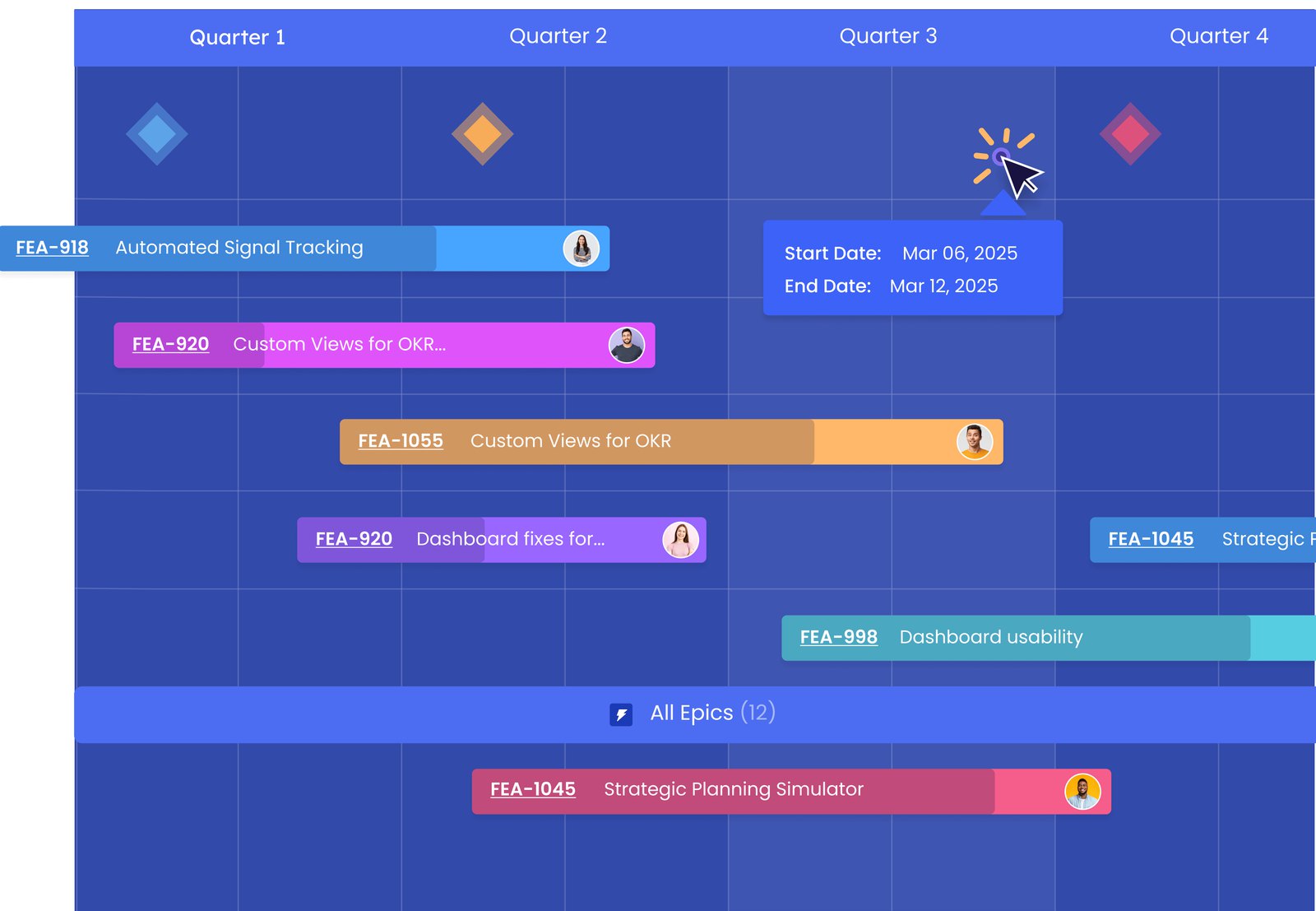
Choose the format by what the audience needs to decide. Timelines suit work with fixed dates and many teams to sequence. Now-Next-Later suits fast-changing priorities. Outcome-based roadmaps suit conversations about value and investment. Many organisations use a timeline for delivery and an outcome view for leadership.
| Format | What it looks like | Use it when | Watch out for |
|---|---|---|---|
| Timeline | Items as bars on a calendar or by PI | Dates matter: regulation, contracts, launches, many teams to sequence | False precision if forecasts look like promises |
| Now, Next, Later | Three columns by time horizon, no dates | Early products, fast-changing priorities, communicating direction | Hard to coordinate many teams or external dates |
| Outcome or goal based | Goals and metrics first, features underneath | Aligning on value and making investment trade-offs | Needs good metrics, or goals become slogans |
| Theme based | Work grouped under strategic themes | Portfolio and executive communication | Can hide what is actually being built |
Now-Next-Later roadmaps
Janna Bastow of ProdPad describes the Now-Next-Later roadmap as a tool that "organizes work into three time horizons, from immediate to long-term", with each item tied back to a business objective.[5] Now holds work the team is confident about and building, Next the problems it expects to pick up, and Later the bigger, less certain problems it wants to keep in view.[5]
Outcome-based and goal-oriented roadmaps
Roman Pichler's GO Product Roadmap puts goals first: its goals "describe outcomes or benefits such as user acquisition, activation, and retention", and features sit underneath them.[6] This shifts the discussion from debating features to deciding where value comes from.
Timeline roadmaps in a scaled organisation
Once several trains depend on each other, or a regulator, customer or event sets a date, a timeline becomes hard to avoid. The answer is not to drop it but to plan features, not tasks, and to show clearly which horizon is committed and which is a forecast.
5. Roadmaps in SAFe and Lean Portfolio Management
In SAFe, roadmaps cascade from strategy to teams. Strategic themes and the portfolio vision shape the portfolio roadmap of epics, which feeds solution roadmaps of capabilities and milestones, which feed PI roadmaps of features. The first PI on a PI roadmap is committed and the next two are a forecast.
Strategy: strategic themes and portfolio vision
Strategic themes are "portfolio-level business objectives that provide competitive differentiation and strategic advantage".[7] The portfolio vision "describes the future state of a portfolio's value streams and solutions" and is a key input to identifying the epics needed to get there.[8]
Portfolio roadmap and Lean Portfolio Management
Lean Portfolio Management "aligns strategy and execution by applying Lean and systems thinking approaches to strategy and investment funding, Agile portfolio operations, and governance".[9] The portfolio roadmap is where that alignment becomes visible: epics, which SAFe defines as "a significant solution development initiative",[10] shown over a multiyear horizon across value streams.[2] For how LPM funds and governs that work, see the Lean Portfolio Management guide.
Solution and product roadmaps
The solution vision "represents the future state of the solution under development".[11] The solution or product roadmap turns it into capabilities, releases and milestones over a longer horizon than a single PI.[2] Milestones and market rhythms, such as trade shows, seasonal peaks or regulatory dates, belong here so trains can plan around them.[2]
PI roadmap
A PI roadmap shows the features an Agile Release Train or Solution Train plans for upcoming PIs. It typically covers three PIs: the first represents committed work and the next two are a forecast.[2] The committed PI comes out of PI Planning, where teams build their plans and PI objectives together.[12]
6. OKR roadmaps: putting objectives on the roadmap
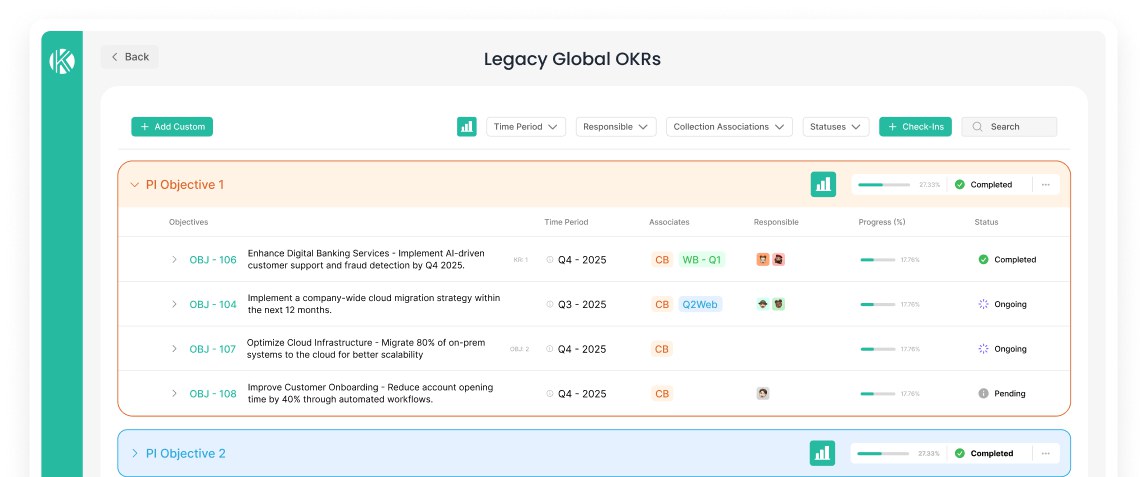
An OKR roadmap shows objectives and key results over time, from strategic themes down to team key results, with the features that deliver each one linked underneath. It tells stakeholders why work is on the roadmap, and lets them track progress by outcome instead of by feature count.
SAFe describes OKRs as "a collaborative framework for establishing clear goals and measurable outcomes" that support transparency and alignment between portfolio strategy and the work of the trains.[13] On a roadmap, that works in three layers:
- Organisational objectives linked to strategic themes, set for the year or half year.
- Program or PI objectives linked to those objectives, set each PI or quarter.
- Team key results that roll up, linked to the features and stories that deliver them.
One caution: OKRs are meant to stretch. Google's re:Work guide puts the "sweet spot" for an OKR grade at 60 to 70%, and treats consistently full attainment as a sign the goals are not ambitious enough.[14] Show OKR progress on the roadmap, but do not read a key result at 70% as a missed commitment.
7. How to build an agile roadmap, step by step
Start from strategy and fixed dates, pick the audience and level, choose a format, fill it with outcomes and features rather than tasks, separate commitment from forecast, connect it to the backlog so it updates itself, and review it on a cadence.
- Start from strategy. Write down the vision, the strategic themes or objectives the roadmap must serve, and any dates that are genuinely fixed.
- Pick the audience and level. Decide whether this is a portfolio, product, solution or PI roadmap. Each audience needs a different level of detail.
- Choose a format. Use a timeline when dates and sequencing matter, Now-Next-Later when direction matters more than dates, and goals first when you need alignment on outcomes.
- Fill it with outcomes and features, not tasks. Put epics, capabilities or features on the roadmap, each linked to the objective it serves. Leave tasks to the teams.
- Separate commitment from forecast. Mark the near term as committed and later horizons as a forecast. In SAFe, the first PI on a PI roadmap is committed and the next two are a forecast.
- Connect it to the backlog. Generate the roadmap from Jira or Azure DevOps data, so progress updates itself instead of living in a slide.
- Review it on a cadence. Revisit the roadmap at every PI Planning or quarterly planning event, and after major changes in strategy or market.
| Roadmap | Review | Typical forum |
|---|---|---|
| Portfolio roadmap | Quarterly | Portfolio sync, strategic portfolio review |
| Solution or product roadmap | Every PI | Pre-Plan, solution management review |
| PI roadmap | Every PI | PI Planning, Inspect and Adapt |
| OKR roadmap | Monthly check-ins, quarterly reset | OKR check-ins, quarterly planning |
8. Roadmap tools for agile teams
Jira offers a timeline per space and cross-space plans in Premium and Enterprise. Azure DevOps offers Delivery Plans across up to 20 team backlogs. Scaled organisations that need portfolio, product, OKR and PI roadmaps on the same data usually add a planning layer such as Kendis on top of Jira or Azure DevOps.
| Tool | Roadmap view | Scope | Notes |
|---|---|---|---|
| Jira Cloud | Timeline and plans | One space, or many in a plan | Timeline is a Gantt-style view of work items; cross-space plans need Jira Premium or Enterprise.[15] |
| Azure Boards | Delivery Plans | Up to 20 team backlogs | Calendar view of team work by sprint, with dependency lines.[16] |
| Kendis | Product, portfolio, OKR, timeline and PI roadmaps | Teams, trains, portfolios | Built from live Jira and Azure DevOps data; group by portfolio, train, team or custom field; presentation mode for reviews. |
Kendis roadmaps are built from the same data as the program board and OKRs, so a feature that slips on the board moves on the roadmap, and an objective's progress rolls up from the work linked to it.
9. Common roadmap mistakes
- Treating forecasts as promises. Label committed and forecast horizons differently.
- Listing features without a why. Link every item to an objective, theme or key result.
- One roadmap for every audience. Executives, trains and customers need different levels of detail.
- A roadmap that lives in slides. It goes stale the week after it is presented. Build it from backlog data.
- Too much detail too far out. Features this PI, epics next quarter, themes beyond that.
- Never removing anything. A roadmap that only grows is a wish list. Review it, and drop what no longer serves the strategy.
Put this into practice, free for 6 months
Kendis is a PI Planning and tracking platform that sits on top of Jira and Azure DevOps. The free trial runs for six months, long enough to plan and track two full PIs with your real backlog before anyone has to approve a budget.
- 6 months free, no credit card
- Choose EU hosting (OVHcloud, Frankfurt) or US hosting (AWS)
- Planning board, dependencies, PI objectives, ROAM risks, solution boards
- Two-way sync with Jira Cloud, Jira Data Center and Azure DevOps
- ISO/IEC 27001 certified, GDPR compliant, DORA Schedule available
- No user caps and no setup costs during the trial
One trial per organisation that has not used Kendis in the last twelve months. After the trial, Premium Cloud is $14 per user per month billed annually, or $16 monthly, and you license only the people who plan. SSO, Kendis AI and premium support are part of paid plans. See pricing and the free trial terms.
Agile roadmaps: frequently asked questions
What is an agile roadmap?
An agile roadmap is a high-level plan of the outcomes, features and milestones a product or organisation intends to deliver over time. It is treated as a forecast, linked to strategy, and reviewed every increment or quarter.
What is the difference between a roadmap and a backlog?
A roadmap shows direction and outcomes over months or years. A backlog is the ordered list of features and stories the teams will work on next. The roadmap sits above the backlog and explains why its items matter.
What are the types of roadmaps?
The main types are product, portfolio, solution, PI, OKR and strategic roadmaps. They differ in scope, owner, content and time horizon.
What is a Now-Next-Later roadmap?
A Now-Next-Later roadmap groups work into three time horizons instead of dates: what the team is building now, what it expects to pick up next, and the larger problems it plans to tackle later.
What is a PI roadmap in SAFe?
A PI roadmap shows the features an Agile Release Train or Solution Train plans for upcoming PIs. It typically covers three PIs: the first is committed and the next two are a forecast.
What is a portfolio roadmap?
A portfolio roadmap shows the epics and major initiatives across a portfolio of value streams over a multiyear horizon. In SAFe it is shaped by strategic themes and the portfolio vision, and managed through Lean Portfolio Management.
What is an OKR roadmap?
An OKR roadmap shows objectives and key results over time, from organisational objectives to team key results, with the features that deliver them linked underneath.
How often should an agile roadmap be updated?
Review PI and product roadmaps every PI or quarter, portfolio roadmaps quarterly, and OKR roadmaps through monthly check-ins with a quarterly reset.
Sources
Every external claim in this guide links to the primary source below. All links were checked on 14 October 2026.
- Scaled Agile, Inc. SAFe Glossary.
- Scaled Agile, Inc. Roadmap (last updated 25 February 2025).
- Atlassian. Product Roadmap Guide: What is it and How to Create One.
- Ken Schwaber and Jeff Sutherland. The Scrum Guide (November 2020).
- Janna Bastow, ProdPad. Why I Invented the Now-Next-Later Roadmap (18 October 2022).
- Roman Pichler. The GO Product Roadmap.
- Scaled Agile, Inc. Strategic Themes.
- Scaled Agile, Inc. Portfolio Vision.
- Scaled Agile, Inc. Lean Portfolio Management.
- Scaled Agile, Inc. Epic.
- Scaled Agile, Inc. Product and Solution Vision.
- Scaled Agile, Inc. PI Planning.
- Scaled Agile, Inc. OKRs (Extended Guidance).
- Google re:Work. Set goals with OKRs (originally published 2016).
- Atlassian Support. What does the space timeline show?.
- Microsoft Learn. Use team delivery plans (Azure Boards).
How this guide is maintained: definitions are checked against the framework pages and other primary sources listed above, and the guide is updated when terminology or guidance changes. Examples, checklists and practical advice are Kendis guidance and are not official SAFe material. SAFe and Scaled Agile Framework are registered trademarks of Scaled Agile, Inc.