Choose Kendis if
- You want PI Objectives, ROAM risks and a confidence vote as real features.
- You need to track the PI after the event against the plan you made.
- You want predictability, scope change and Inspect and Adapt reports.
- Your Jira Data Center or Azure DevOps Server is not open to the public internet.
- You plan across several ARTs and need a solution-level view.
Choose Miro if
- You need a free-form canvas for workshops, retrospectives and brainstorming.
- Your company already owns Miro and everyone knows how to use it.
- You plan lightly and do not need structured objectives, risks or reports.
- You want one tool for many kinds of collaboration beyond agile planning.
What is the best Miro alternative for PI Planning?
Kendis is a strong Miro alternative for PI Planning because it is built for that event and for the 8 to 12 weeks after it. It provides a program board, dependencies, PI Objectives with business value, a ROAM risk register, a confidence vote and predictability reports, synced two-way with Jira and Azure DevOps.
Miro is a general-purpose visual workspace. Its PI Planning offer is a set of tools on a Miro board: Planner, Dependencies, Jira Cards and Azure Cards.[1] They are capable, and Jira Cards sync both ways immediately.[2] The difference is what happens around them. Objectives, risks and voting on a whiteboard are frames and sticky notes. In Kendis they are records with owners, values and history that feed the reports you use for the rest of the PI.
Kendis vs Miro at a glance
| Kendis | Miro | |
|---|---|---|
| Type of product | Purpose-built PI Planning and tracking tool | General-purpose visual workspace with PI Planning tools[1] |
| Pricing | $14 per user per month billed annually, $16 monthly. You license the people who plan, not every Jira user. Pricing | Planner and Dependencies need the Business plan, $20 per member per month billed yearly, or Enterprise.[3] |
| Free option | 6 months free, no credit card | Free plan, and a 14-day Business trial. Planner and Dependencies are not in Free or Starter.[3] |
| Deployment | Cloud or self-hosted on your own infrastructure | Cloud |
| Hosting region | Your choice at signup: EU (OVHcloud, Frankfurt) or US (AWS) | EU data residency on all plans (Ireland, backup in Germany). US, AU and JP on Enterprise.[4] |
| Jira | Jira Cloud and Jira Data Center, two-way | Jira Cloud, Server and Data Center through Jira Cards[2] |
| Azure DevOps | Azure DevOps and TFS, two-way | Azure DevOps Services (cloud) through Azure Cards, Business and Enterprise[5] |
| On-premise ALM | Supported, including self-hosted Kendis behind your firewall | On-premise Jira must be "open to the public internet"[6] |
| Security | ISO/IEC 27001 certified, GDPR compliant, DORA Schedule available | ISO/IEC 27001, SOC 2 Type II, GDPR[7] |
How do Kendis and Miro compare on PI Planning features?
Miro documents a planning grid, dependency mapping and manual capacity for Jira and Azure DevOps cards. Kendis adds structured PI Objectives, a ROAM risk register, a dedicated confidence vote, predictability and scope change reports, Inspect and Adapt and solution-level boards.
| Feature | Kendis | Miro |
|---|---|---|
| Planning board | Yes. Program board with team rows and iteration columns | Yes. Planner, a grid of Jira or Azure cards by sprint, status or field[8] |
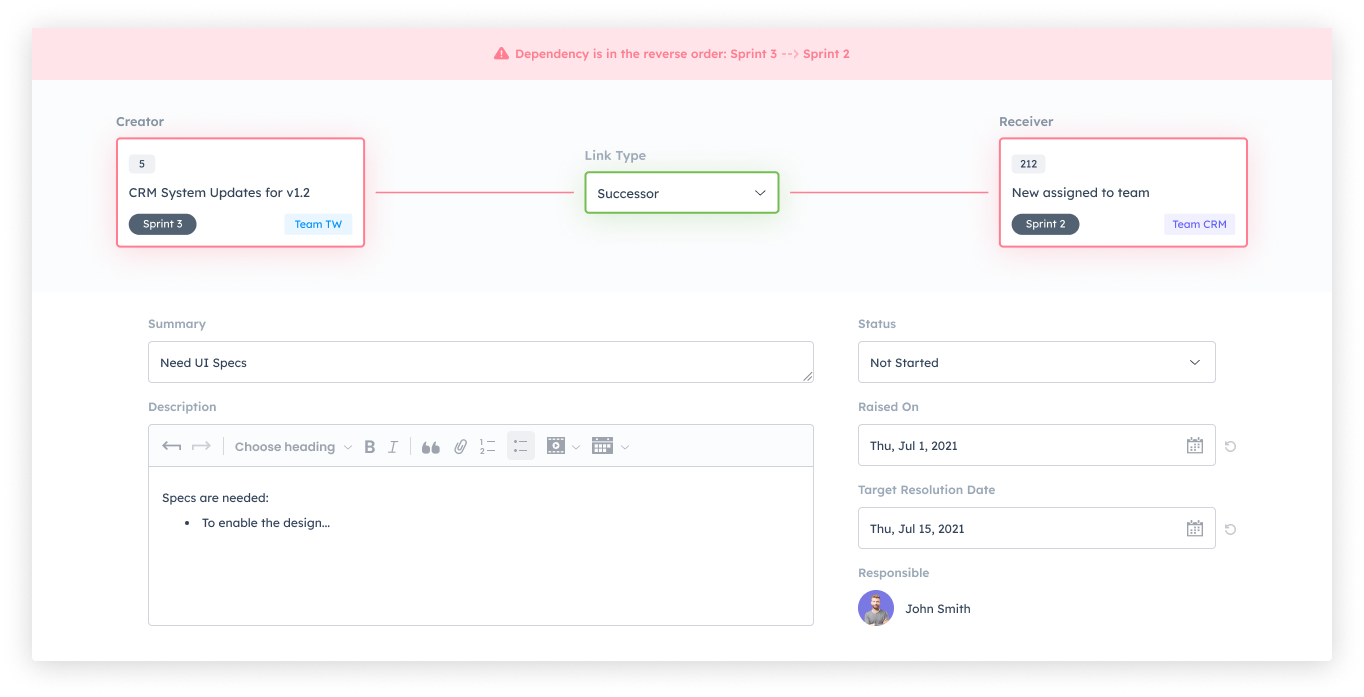
| Dependency management | Yes. Lines on the board, list view, dependency wheel, due dates and alerts | Yes. Dependencies between Jira cards, synced to Jira[9] |
| Capacity and load | Yes. Capacity per team per iteration against planned load | Yes. Capacity entered manually per column[8] |
| Sync from Jira or Azure DevOps into the plan | Automatic | Jira Cards update immediately.[2] Planner shows "Updates available" and needs a click to sync.[8] |
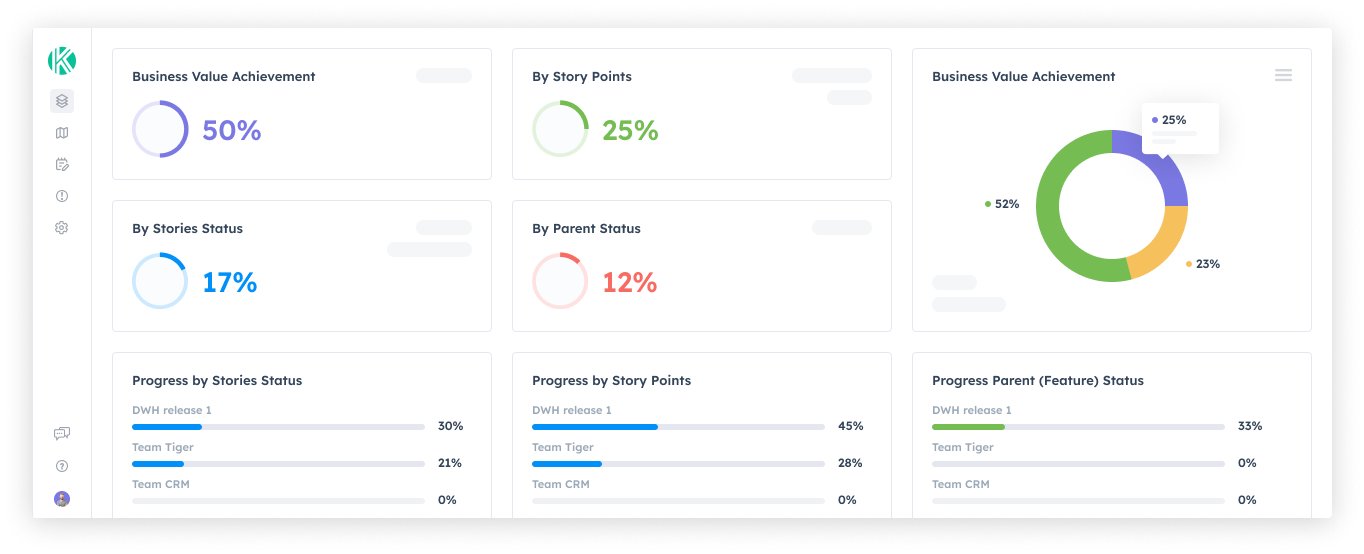
| PI Objectives with business value | Yes. Planned and actual business value, linked to features and stories | Not documented |
| ROAM risks | Yes. ROAM risk register linked to features | Not documented |
| Confidence vote | Yes. Per team and for the whole PI | Generic voting tool[1] |
| Predictability and PI reports | Yes. Predictability and performance reports | Not documented |
| Inspect and Adapt | Yes. Inspect and Adapt module with PI comparisons | Not documented |
| Solution Train / multi-ART | Yes. Solution board across ARTs, mixing Jira and Azure DevOps boards | Not documented |
| Free-form whiteboard | Yes. Collab Board for retrospectives and workshops | Yes. Miro's core strength |
Miro also documents some limits that matter on the day: Miro cards and sticky notes cannot be placed inside a Planner, closed sprints cannot be displayed, and a Planner on Azure DevOps needs a manual sync to pick up changes.[8][10]
When is Miro the better choice?
Choose Miro when the session is exploratory: discovery workshops, retrospectives, story mapping or any meeting where people need an open canvas more than a structured plan.
- Open-ended facilitation. Voting, timer, private mode and estimation tools on an infinite canvas.[1]
- Familiarity. Many organisations already own Miro, so participants need no new tool.
- Scale of participation. Miro states that PI Planning sessions "may involve a few hundred participants" on one board.[11]
- Certifications and residency. ISO/IEC 27001 and SOC 2 Type II[7], with EU data residency on every plan.[4]
Plenty of trains use both: Miro for the retrospective and problem-solving workshop, and a planning tool for the plan itself.
Why do teams choose Kendis instead of Miro for PI Planning?
Teams move from Miro to Kendis when they want the plan to remain useful after day two. The reasons are structured objectives and risks, tracking against the baseline, and less manual upkeep.
The plan becomes the tracking board
When planning ends, Kendis keeps a baseline and switches to tracking. You can see which features were added after planning, which stories changed iteration and how each team is progressing, week by week. A whiteboard shows what was agreed and stays that way.
Objectives and risks are data
In Kendis a PI Objective has a planned and an actual business value and is linked to the features that deliver it. A risk has a ROAM status, an owner, a target date and the features it threatens. That is what makes predictability reports and Inspect and Adapt possible without anyone rebuilding the numbers by hand.
Works with tools behind your firewall
Miro's Jira Cards can connect to an on-premise Jira only when the instance is open to the public internet.[6] Kendis can be self-hosted next to your Jira Data Center or Azure DevOps Server, so nothing has to be exposed.
Priced for planners
Miro's Planner and Dependencies need the Business plan at $20 per member per month, billed yearly.[3] Kendis is $14 per user per month on annual billing, licensed only for the people who plan. If your company already pays for Miro for everyone, Miro costs nothing extra, and that is a fair reason to stay.
How do you try Kendis alongside Miro?
You do not need to replace anything to evaluate Kendis. It reads from and writes to the Jira or Azure DevOps backlog you already have, so you can run it next to Miro for a PI and compare the two on real work.
- Sign up for the six-month free trial and pick EU or US hosting. No credit card is asked for.
- Connect Jira or Azure DevOps and choose the boards or projects for one Agile Release Train.
- Load the features for the next PI with a JQL filter or Azure DevOps query. Linked stories come in with them.
- Run PI Planning on the board: capacity, dependencies, objectives, ROAM and the confidence vote.
- Track the PI against the planning baseline, then decide with two PIs of evidence.
Keep Miro for workshops if you like it. Kendis also has a built-in Collab Board linked to each program board, for retrospectives and problem-solving sessions.
Try Kendis free for 6 months
Kendis is a PI Planning and tracking platform that sits on top of Jira and Azure DevOps. The free trial runs for six months, long enough to plan and track two full PIs with your real backlog before anyone has to approve a budget.
- 6 months free, no credit card
- Choose EU hosting (OVHcloud, Frankfurt) or US hosting (AWS)
- Planning board, dependencies, PI objectives, ROAM risks, solution boards
- Two-way sync with Jira Cloud, Jira Data Center and Azure DevOps
- ISO/IEC 27001 certified, GDPR compliant, DORA Schedule available
- No user caps and no setup costs during the trial
One trial per organisation that has not used Kendis in the last twelve months. After the trial, Premium Cloud is $14 per user per month billed annually, or $16 monthly, and you license only the people who plan. SSO, Kendis AI and premium support are part of paid plans. See pricing and the free trial terms.
Compare Kendis with other PI Planning tools
New to the topic? Read the PI Planning guide or the scaling agile guide.
Kendis vs Miro: frequently asked questions
What is the best alternative to Miro for PI Planning?
Kendis is a purpose-built alternative. It provides a program board, dependencies, PI Objectives with business value, a ROAM risk register, a confidence vote and predictability reports, synced two-way with Jira and Azure DevOps.
Can you do PI Planning in Miro?
Yes. Miro offers Planner, Dependencies, Jira Cards and Azure Cards for PI Planning on its Business and Enterprise plans. Objectives, ROAM risks and reports are not structured features in Miro's documentation and are usually built as frames and sticky notes.
Does Miro sync with Jira in real time?
Jira Cards in Miro sync both ways immediately. The Planner for Jira updates Jira automatically, but changes made in Jira show an "Updates available" notice in the Planner and need a click to sync.
Does Miro work with Azure DevOps?
Yes, on Business and Enterprise plans. Azure Cards import work items from Azure DevOps Services, the cloud product. Kendis syncs two-way with Azure DevOps and TFS.
How much does Miro cost for PI Planning?
Miro's Planner and Dependencies are included in the Business plan at $20 per member per month billed yearly, and in Enterprise. They are not in the Free or Starter plans. Kendis is $14 per user per month on annual billing, with six months free.
Does Miro have a ROAM board or PI Objectives?
Miro's help centre does not document a structured ROAM board or PI Objectives feature. Teams build them from templates as free-form content. Kendis has both as built-in features that feed its reports.
Can I use Kendis and Miro together?
Yes. Many trains plan and track in Kendis and use a whiteboard for retrospectives and workshops. Kendis also includes its own Collab Board for that purpose.
Does Kendis have a whiteboard?
Yes. The Kendis Collab Board is a digital whiteboard with sticky notes, shapes, connectors and templates, linked to a program board or solution board.
Sources
Every external claim in this guide links to the primary source below. All links were checked on 12 October 2026.
- Miro. PI Planning in Miro.
- Miro. Jira Cards.
- Miro. Pricing.
- Miro. Data residency at Miro.
- Miro. Azure Cards.
- Miro. Jira Cards FAQ.
- Miro. Trust Center.
- Miro. Planner for Jira.
- Miro. Dependencies for Jira.
- Miro. Planner for Azure DevOps.
- Miro. How many users can collaborate on a board simultaneously?.
How this comparison was made: statements about Miro come from the vendor's own website, documentation and marketplace listing, linked above and checked on 12 October 2026. Statements about Kendis come from Kendis. Products change, so if something here is out of date, tell us and we will correct it. All product names are trademarks of their respective owners.